When the Mountains Broke: My Thoughts on Nepal’s Floods and the Climate Crisis We Didn’t Create
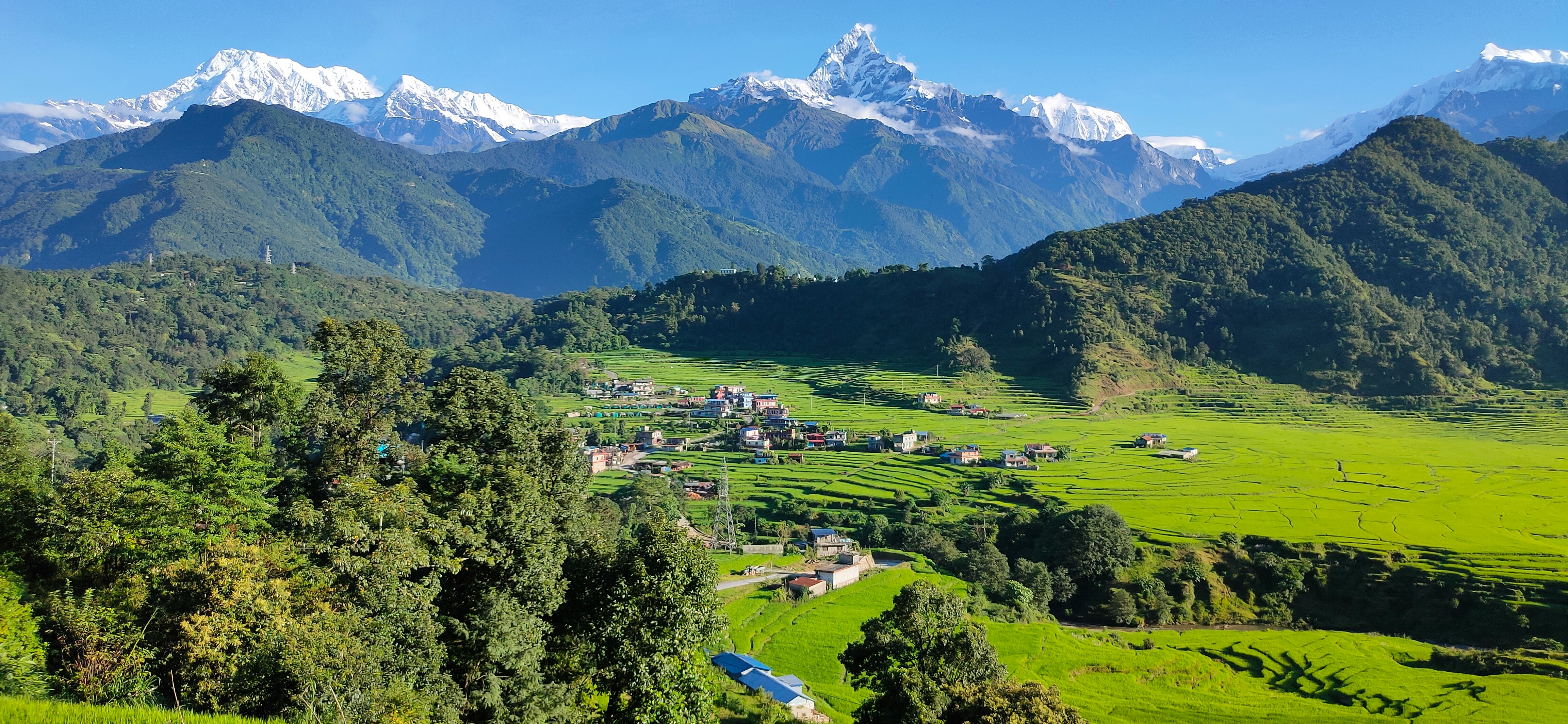
I grew up looking at Himalaya. Every Nepali does. It doesn’t matter if you were born in Butwal like me, or in Kathmandu, or in a small village near Everest — the mountains are part of who we are. They are on our flag, in our songs, in the stories our grandparents told us. So when I saw the news this week, I felt something break inside me too.
In the last week of August 2026, a massive chunk of glacier ice broke away high in the mountains along the Nepal-China border, near the Lhende Khola in Rasuwa district. It happened at an altitude of over 5,200 meters. Within minutes, that ice turned into a wall of water, rock, mud, and debris that came crashing down through the Trishuli river valley. Villages in Rasuwa and Nuwakot were buried. Hydropower plants, bridges, roads and homes were destroyed in seconds. As I write this, more than 300 people have been confirmed dead, and well over a thousand people, including many foreign trekkers, are still missing. The scale of this tragedy is still growing.
At first, nobody understood what had happened. The sky was clear. There had been no heavy rainfall. Seismic instruments picked up a signal that looked like an earthquake, so Nepal’s own foreign minister initially said an earthquake had triggered an avalanche. But scientists from the US Geological Survey later found that the “earthquake” signal wasn’t a real tectonic quake at all — it was the shockwave created by the glacier collapse itself. In other words, the mountain didn’t shake and then break. The mountain broke, and that breaking is what shook the ground.
This is not the first time something like this has happened, and that is exactly what worries me the most.
This Has Happened Before, and It Keeps Getting Worse
I looked into Nepal’s recent flood history, and honestly, the pattern is frightening.
– In 2024, two glacial lakes burst above Thame village in the Everest region, damaging homes downstream in a sudden glacial lake outburst flood, known as a GLOF.
– In 2025, a GLOF hit Tilgau village in Humla district in May, destroying five bridges and displacing dozens of families, again with no rainfall involved.
– Just two months later in July 2025, a flash flood at Rasuwagadhi, caused by monsoon rain combined with a likely glacial lake outburst, swept away infrastructure in the very same region that has now been hit again in 2026.
Do you see the pattern? Rasuwa. Nuwakot. Humla. Solukhumbu. Again and again, it is our high mountain districts that are paying the price. And in nearly every case, scientists point to the same underlying cause: our glaciers are melting and breaking apart faster than ever before.
What Is Actually Happening to Our Glaciers
I wanted to understand the real science behind this, not just the headlines, so I dug into the research from ICIMOD (the International Centre for Integrated Mountain Development), which is actually based right here in Kathmandu.
Here is what I found:
The Hindu Kush Himalaya region stretches across eight countries, including Nepal, and contains more than 63,000 glaciers. These glaciers are often called the “Third Pole” because they hold the largest amount of ice and snow outside the North and South Poles. More than 240 million people live in these mountains, and another 1.65 billion people downstream depend on the rivers that flow from this ice.
ICIMOD reported in March 2026 that glacier ice-loss rates across the entire Hindu Kush Himalaya region have roughly doubled since the year 2000. Even more alarming, an earlier ICIMOD study found that glaciers in this region melted 65% faster between 2011 and 2020 than they did in the previous decade. That is not a slow, gentle change. That is a rapid acceleration happening within a single human generation.
And it gets worse when I looked at the long-term projections. According to ICIMOD’s landmark 2023 report, if the world continues on its current path, at 3 degrees Celsius of global warming, glaciers in the Eastern Himalaya, which includes Nepal, could lose up to 75% of their ice volume by the year 2100. At 4 degrees of warming, that number rises to 80%. Even in the most optimistic case, if the world manages to limit warming to 1.5 or 2 degrees Celsius, our glaciers would still lose 30 to 50% of their volume by the end of this century.
Nearly 80% of the glacier area in this region sits between 4,500 and 6,000 meters above sea level, exactly the zone that is now heating up fastest. As this ice retreats, the mountain rock underneath it, which was frozen and locked in place for centuries, gets exposed. Permafrost, which is ground that stays frozen year-round, begins to thaw. Slopes that were once stable become weak and unstable. This is very likely part of what caused the glacier collapse we just witnessed.
Why This Turns Into Floods
I used to think a flood needed heavy rain. But mountain floods work differently, and now I understand why.
As glaciers melt, they often form glacial lakes, held back only by natural walls of ice, rock and loose debris called moraines. These walls are not solid dams built by engineers. They are fragile, temporary barriers. When more meltwater pours in, or when a piece of rock or ice crashes into the lake, the wall can suddenly give way. All the water that had built up over months or years is released in minutes. This is called a Glacial Lake Outburst Flood, or GLOF.
Researchers published in the journal Nature in 2023 estimated that around 15 million people worldwide live within 50 kilometers of a glacial lake with outburst flood risk, and the vast majority of them live right here in the Himalaya. In this latest 2026 disaster, satellite images before the event apparently did not show a large lake at that exact spot, so scientists believe this particular event was a direct glacier collapse rather than a classic GLOF. But experts agree both types of disaster come from the same root cause: a warming climate destabilizing high-altitude ice.
Dr. Ella Gilbert, a climate scientist at the British Antarctic Survey, put it simply after this disaster: climate heating is destabilizing glaciers in the Himalaya, and when that stability is undermined, sudden and horrifying failures like this one become more likely.
The Mountains I Remember Are Disappearing
Anyone older than me in Nepal will tell you the same thing. The mountains used to hold snow almost all year round. Now, in many places, the snow line is climbing higher every year, and bare rock shows through where there used to be white peaks even in months that used to be reliably frozen.
This isn’t just nostalgia. Scientific glacier surveys back this up. Nepal’s total glaciated area shrank from 3.6% to 2.6% of the country’s land area between 1977 and 2010. In that same period, 163 smaller glaciers disappeared completely. Interestingly, researchers found that the total number of glaciers actually increased slightly, from 3,429 to 3,808, because large glaciers are fragmenting and breaking apart into smaller pieces as they die. Smaller glaciers are losing their ice even faster than the big ones.
Along with the disappearing snow comes something else I have read about: strange, sudden new waterfalls and streams appearing on mountainsides that didn’t have them before, simply because ancient ice is turning into liquid water for the first time in centuries. It’s a strange kind of proof, water pouring out of places that used to be permanently frozen solid.
Our Animals Are Losing Their Homes Too
This part of the research honestly broke my heart a little. It’s not just people who are suffering.
The snow leopard, one of the most iconic and endangered animals of our mountains, is losing its home. Scientific studies show that as temperatures rise, the tree line is shifting upward, shrinking the high, cold, treeless alpine zones that snow leopards need to survive. One widely cited WWF study estimated that up to 30% of snow leopard habitat in the Himalaya could be lost due to this “treeline shift” if emissions keep rising. Researchers have called this the “escalator to extinction,” because these animals can only climb so much higher before there is no more mountain left.
It’s not just the snow leopard. The prey it depends on, animals like blue sheep, Himalayan tahr, and the small mountain-dwelling pika, are also affected. A study in the central Nepal Himalaya found that pika population density has already been decreasing. Since snow leopards rely heavily on these prey animals for food, the whole food chain in our mountains is under stress at the same time as the ice itself is vanishing.
Here Is the Part That Makes Me Angry: We Barely Pollute, Yet We Suffer the Most
This is the part of my research that I most wanted to write about, because it feels deeply unfair.
Nepal produces an extremely small share of the world’s greenhouse gas emissions, somewhere around 0.1% of the global total. Our per-person emissions are roughly 2 tonnes of CO2-equivalent per year, and even that is mostly from agriculture and livestock, not big industry. We don’t have giant coal power plants. We don’t have fleets of factories pumping smoke into the sky. Nepal ranks near the very bottom, 164th out of 190 countries, in emissions per person.
Now compare that to the countries actually driving global warming. In 2024, China alone accounted for roughly 29 to 30% of the entire world’s greenhouse gas emissions, more than any other nation by a wide margin. The United States and India followed behind it. Together, these three countries alone were responsible for close to half of the world’s total emissions in 2024. On a per-person basis, it gets even more stark: in 2023, the average person in Russia produced about 19 tonnes of CO2-equivalent, the average American produced about 18 tonnes, and the average person in China produced about 11 tonnes. Compare that to a Nepali citizen’s roughly 2 tonnes.
In simple terms, one American, on a per-person basis, produces roughly nine times more climate pollution in a year than one Nepali does. Yet it is not Washington or Beijing that just buried villages under mud and ice. It is Rasuwa. It is Nuwakot. It is our people.
Amina Maharjan, a migration specialist and co-author of the ICIMOD Hindu Kush Himalaya report, said something that has stuck with me: the people living in these mountains have contributed next to nothing to global warming, yet they are the ones at the highest risk. She’s right. This isn’t a coincidence, it’s a pattern that climate scientists have documented across the world. The countries and communities that pollute the least are usually the ones least equipped to protect themselves, and most exposed to the consequences.
Are Scientists Sure This Specific Flood Was “Caused” by Global Warming?
I want to be honest here, because I don’t want to exaggerate anything in this article. Right after the disaster, several scientists were careful to say it is too early to draw a direct, one-to-one line between this exact glacier collapse and global warming. Mountains can fail due to gravity, geology, and natural instability even without climate change involved.
But here is what almost every expert I read agrees on, without exception: rising global temperatures are making these kinds of disasters far more likely and far more frequent. As the International Centre for Integrated Mountain Development put it, the Hindu Kush Himalaya is warming rapidly, and that warming is driving major, largely irreversible changes to glaciers, snow cover, and permafrost. Saswat Sanyal, a disaster risk specialist at ICIMOD, said it plainly after the disaster: rising temperatures are changing this region and melting its glaciers, and unfortunately, what just happened may be “the new normal.”
That sentence stayed with me. The new normal. Not a one-time tragedy, but a preview of what is coming again and again if nothing changes.
What I Think We Need to Do
I’m not a scientist. I’m a marketer who grew up watching these mountains from a distance. But after doing all this research, here is what I honestly believe:
The countries producing the overwhelming majority of global emissions, China, the United States, India, Russia, and a handful of others, carry the greatest responsibility to cut their emissions fast, and to genuinely help fund climate adaptation in vulnerable, low-emission countries like ours. Nepal cannot fix a crisis it did not create, at least not alone.
At the same time, Nepal and the international community need serious investment in early warning systems for our mountain communities, better GLOF monitoring for the thousands of glacial lakes across our region, and stronger infrastructure that can survive these events when they happen. Nepal has already grown its forest cover to 46% of the country and recently received funding through the World Bank’s Forest Carbon Partnership Facility, which is genuinely something to be proud of. We are doing our part despite contributing almost nothing to the problem.
And on a personal level, I think the least I can do is write this article, and hope more people, especially people living in the countries producing the most emissions, understand that their choices about energy and pollution are directly connected to villages disappearing under ice and mud on the other side of the world.
A Final Thought From Someone Watching From Abroad
I live and work far from those mountains now, in Sharjah, but Nepal is still home. Reading through the science, the reports, the numbers, one thing became painfully clear to me: our glaciers are not just retreating slowly like a tide going out. They are becoming unstable, unpredictable, and dangerous, and the people paying for that instability are almost never the people who caused it.
The Himalaya has stood for millions of years, shaping the culture, water, and identity of an entire region. But it is changing faster now than at almost any point in recorded history, and it’s changing because of decisions made mostly outside our borders. I hope that by understanding this clearly, and sharing it honestly, more people, in Nepal and around the world, will start to see our mountains not just as a beautiful backdrop, but as an early warning system for the whole planet.
